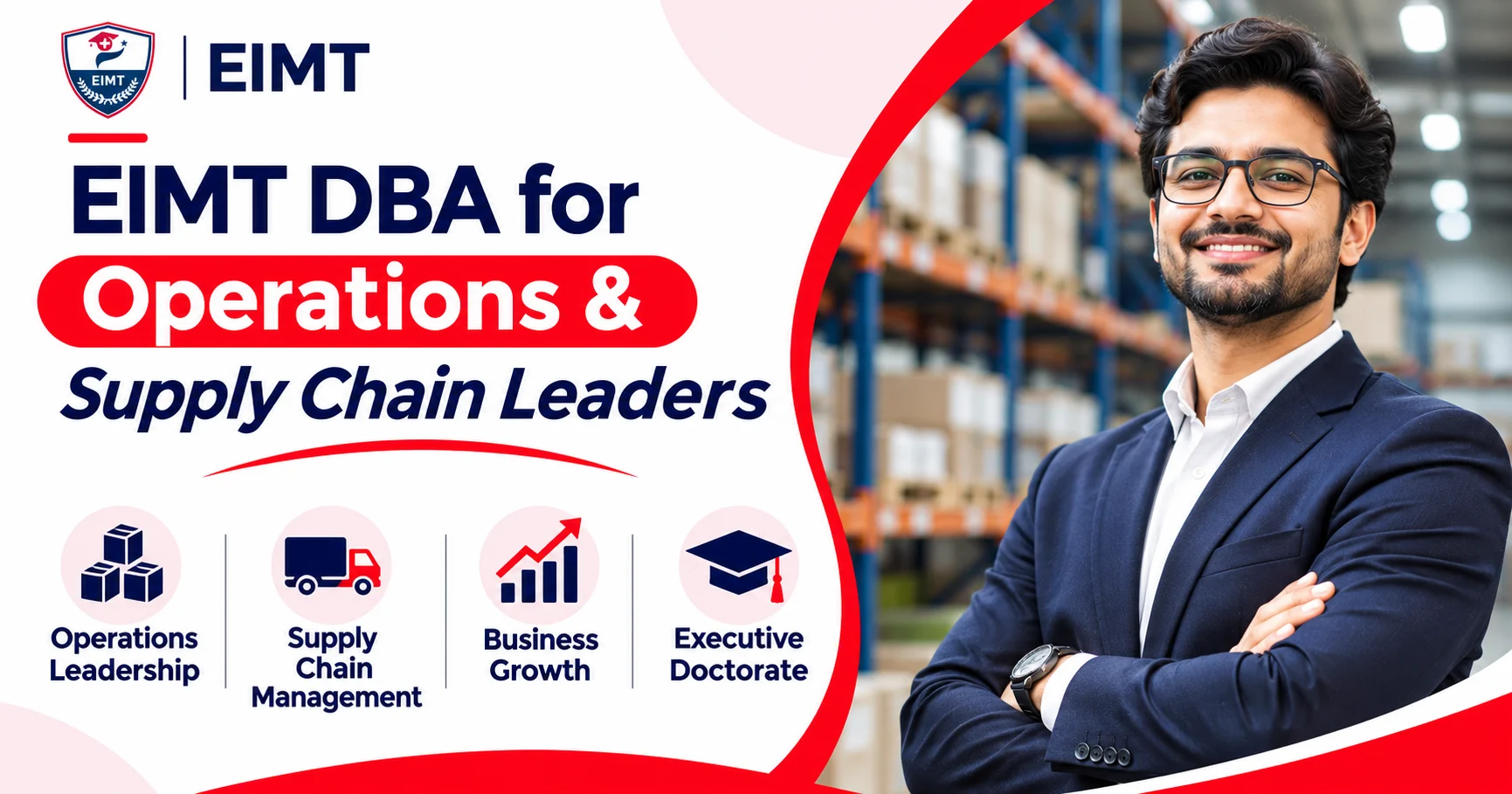
Operations and supply chain leaders play an important role in keeping businesses efficient, competitive and resilient. From managing procurement and inventory to improving production, logistics and supplier relationships, their decisions directly influence organisational performance.
However, as businesses expand across markets and adopt new technologies, operations professionals need more than technical expertise. They must understand strategic management, financial planning, innovation, risk management and organisational leadership.
A Doctorate in Business Administration can help experienced professionals examine these challenges through structured research and develop practical solutions for their organisations.
The European Institute of Management and Technology DBA, commonly known as the EIMT DBA, is an online doctoral programme designed for experienced working professionals. Its curriculum includes a dedicated subject in Supply Chain and Operations Management, making it relevant to professionals who want to connect operational experience with advanced business research.
This guide explains the programme structure, supply chain-related learning, eligibility, dissertation ideas, career opportunities and recognition considerations for operations and supply chain leaders.
EIMT DBA Programme Overview
The EIMT Doctorate in Business Administration is a research-based programme designed for professionals who want to strengthen their management knowledge and investigate real organisational challenges.
The university describes the DBA as a three-year online programme. It combines advanced management coursework, research methods, academic supervision and a practitioner-based dissertation.
| Programme Details | Information |
|---|---|
| Institution | European Institute of Management and Technology |
| Programme | Doctorate in Business Administration |
| Learning Mode | Online |
| Advertised Duration | 36 months |
| Programme Structure | Coursework and doctoral research |
| Research Component | Practitioner-based project and dissertation |
| Relevant Subject | Supply Chain and Operations Management |
| Eligibility | Recognised master’s degree or equivalent |
| Work Experience | Designed for experienced professionals |
| GMAT/GRE | Not required for standard admission |
The programme is intended for working professionals who want to pursue doctoral-level education without putting their careers on hold.
Why Should Operations Leaders Consider the EIMT DBA?
Operations managers are responsible for improving productivity, managing resources, controlling costs and ensuring that business processes run smoothly.
As organisations become more complex, these responsibilities increasingly involve strategic decisions rather than routine operational supervision.
A DBA can help experienced operations professionals examine business challenges using research methods and management frameworks.
1. Develop Strategic Operations Management Skills
Operations leaders must understand how different business functions work together. Procurement, production, inventory, distribution and customer service all influence organisational performance.
The EIMT DBA includes strategic management and operations-related learning that can help professionals examine these functions from a broader management perspective.
For example, an operations manager could investigate how production planning affects delivery performance or how process redesign influences operating costs.
2. Improve Supply Chain Management Knowledge
Modern supply chains involve suppliers, manufacturers, distributors, logistics providers and customers across different locations.
Disruptions, changing demand, transportation delays and supplier-related risks can affect the entire business.
The EIMT DBA curriculum brochure includes a dedicated subject called Supply Chain and Operations Management. This makes the programme particularly relevant to professionals who want to investigate supply chain performance and operational decision-making.
Potential learning applications include:
- Supply chain planning and coordination.
- Procurement and supplier management.
- Inventory control.
- Logistics and distribution.
- Production planning.
- Operational efficiency.
- Supply chain risk management.
Candidates should confirm that this subject remains part of the curriculum for their particular intake because programme materials can be updated.
3. Strengthen Business Research Capabilities
Experienced operations professionals often identify problems through their daily work. However, solving complex organisational challenges requires more than identifying symptoms.
A research-based approach can help professionals investigate the causes of operational inefficiencies and evaluate possible solutions.
The programme includes research capability development, advanced research design and methodologies, and dissertation work.
These subjects can help learners understand how to formulate research questions, examine existing studies, select appropriate methods and interpret findings.
4. Understand Innovation and Digital Transformation
Technology is changing how businesses manage production, procurement, warehousing and distribution.
Automation, predictive analytics, artificial intelligence and digital supply chain platforms are becoming increasingly important for operational decision-making.
The EIMT curriculum includes entrepreneurship and innovation, strategic management and technology-related business considerations.
For operations leaders, this knowledge can support research into how organisations introduce new systems, manage digital transformation and improve operational performance.
5. Develop Global Management and Leadership Skills
Supply chain operations often involve international suppliers, cross-border logistics and multicultural teams.
Managers must understand how business decisions are influenced by global markets, organisational structures and corporate governance.
The DBA’s curriculum includes Globalisation and Corporate Governance, Strategic Management and Leadership Potential, and International Project Management.
These subjects may help professionals develop a wider understanding of international business operations.
EIMT DBA Curriculum for Operations and Supply Chain Leaders
The published EIMT DBA brochure outlines a three-year academic structure with management subjects, research development and a dissertation.
The following curriculum details are based on the available programme roadmap. Candidates should request the latest approved study plan before admission.
Year 1: Management and Research Foundations
| Subject | Credits |
|---|---|
| Developing Research Capability | 10 ECTS |
| Advanced Research Design and Methodologies | 20 ECTS |
| Strategic Human Resource Management | 10 ECTS |
| Strategic Financial Management | 10 ECTS |
| Strategic Marketing | 10 ECTS |
| Total | 60 ECTS |
The first year introduces candidates to research methods and important business management functions.
Operations professionals can use this foundation to understand how financial, marketing and workforce decisions influence operational performance.
Year 2: Strategy, Operations and Innovation
| Subject | Credits |
|---|---|
| Managing Strategic Change | 10 ECTS |
| Project Development, Planning and Management | 20 ECTS |
| Developing Strategic Management and Leadership Potential | 10 ECTS |
| Supply Chain and Operations Management | 10 ECTS |
| Entrepreneurship and Innovation | 10 ECTS |
| Globalisation and Corporate Governance | 10 ECTS |
| Total | 70 ECTS |
This is particularly relevant for operations and supply chain professionals because it includes a dedicated Supply Chain and Operations Management subject.
The project management component can also help professionals examine planning, execution and resource allocation in complex business environments.
Year 3: Research and Dissertation
| Subject | Credits |
|---|---|
| Research and Dissertation | 60 ECTS |
| Total | 60 ECTS |
The final year focuses on doctoral research and the completion of the dissertation.
The complete roadmap lists 180 ECTS across the three-year programme.
Best DBA Dissertation Topics for Operations and Supply Chain Leaders
A DBA dissertation gives professionals an opportunity to investigate a real business challenge in depth.
For operations managers, this may involve production efficiency, inventory planning, supplier relationships or organisational transformation.
Here are some potential dissertation topics:
| Research Area | Suggested Dissertation Topic |
|---|---|
| Supply Chain Resilience | Strategies for improving supply chain resilience during global disruptions |
| Inventory Management | Impact of inventory optimisation on business profitability |
| Procurement | Role of strategic procurement in reducing organisational costs |
| Logistics | Influence of logistics efficiency on customer satisfaction |
| Production Planning | Effect of production planning systems on manufacturing performance |
| Supplier Management | Relationship between supplier collaboration and supply chain performance |
| Digital Transformation | Impact of digital technologies on supply chain operations |
| AI in Operations | Use of predictive analytics for demand forecasting |
| Warehouse Management | Role of automation in improving warehouse productivity |
| Risk Management | Strategies for managing operational and supply chain risks |
| Sustainability | Sustainable supply chain practices in manufacturing companies |
| Lean Management | Impact of lean operations on productivity and waste reduction |
Professionals should select a research topic that connects with their experience and allows access to relevant organisational information.
The topic should also be suitable for academic investigation and approved through the university’s research supervision process.
Who Should Consider the EIMT DBA?
The programme may be relevant to experienced professionals who already have responsibilities in operations, logistics, procurement or supply chain management.
1. Supply Chain Managers
Professionals responsible for coordinating suppliers, procurement, inventory and distribution can explore strategies for improving supply chain performance.
2. Operations Managers
Operations managers can investigate productivity, resource allocation, process improvement and organisational efficiency.
3. Logistics Managers
Professionals managing transportation, warehousing and distribution may benefit from studying logistics strategy and operational planning.
4. Procurement Directors
Senior procurement professionals can examine supplier relationships, purchasing strategies, sourcing risks and cost optimisation.
5. Manufacturing Leaders
Production managers and manufacturing heads can research process efficiency, production planning, quality management and technology adoption.
6. Warehouse and Inventory Managers
Professionals responsible for inventory control and warehouse operations can investigate automation, stock optimisation and distribution efficiency.
7. Operations Consultants
Consultants who advise businesses on process improvement, supply chain performance and operational strategy may use doctoral research to develop specialised expertise.
EIMT DBA Eligibility for Operations Professionals
The EIMT DBA is designed for experienced professionals with postgraduate-level academic qualifications.
The published admission requirements specify:
- A recognised master’s degree or equivalent EQF Level 7 qualification.
- A minimum overall score of 55% or an equivalent GPA of 2.0 on a 4.0 scale.
- English language proficiency, generally demonstrated through IELTS 6.5 or an accepted equivalent where required.
- Basic digital competence for online learning.
English proficiency waivers may be available for applicants who meet the university’s stated conditions, such as previous English-medium education or relevant professional experience in an English-speaking organisation.
An MBA is not compulsory according to the published entry requirements. Applicants with a recognised master’s degree in another discipline may also be considered.
Documents Required for Admission
Candidates may be asked to submit:
- Bachelor’s degree certificate and transcripts.
- Master’s degree certificate and transcripts.
- Updated professional resume.
- Government-issued identification.
- English proficiency documents, if applicable.
- Additional documents requested by the admissions team.
Operations and supply chain professionals should also prepare a brief explanation of their professional responsibilities and potential research interests.
How Does the EIMT Online DBA Work?
The EIMT DBA is delivered online and combines coursework, research activities, supervision and dissertation development.
This structure may be useful for professionals who cannot leave their jobs to pursue full-time doctoral education.
The programme generally follows three stages.
Coursework: Students complete subjects related to financial management, strategic leadership, operations, innovation, global business and research.
Research Development: Candidates identify a research problem, prepare a preliminary proposal and develop their research methodology with academic guidance.
Dissertation: Students complete their applied research, analyse the findings and prepare their final dissertation for assessment and defence.
The programme brochure describes a semester-based learning structure, with live virtual learning in the initial stage and further guidance, assignments and self-paced learning in subsequent stages.
The university also describes one-to-one supervision and support from research faculty.
Candidates should confirm the exact schedule, supervisor allocation, dissertation milestones and assessment requirements for their intake.
Career Opportunities After the EIMT DBA
A DBA can help experienced operations and supply chain professionals strengthen their strategic management and research capabilities.
It may be relevant to people who want to move into broader leadership positions or develop specialised consulting expertise.
| Career Role | Key Responsibilities |
|---|---|
| Chief Operating Officer | Oversee business operations and organisational performance |
| Supply Chain Director | Manage end-to-end supply chain strategy |
| Operations Director | Lead operational planning and process improvement |
| Procurement Director | Develop sourcing and supplier management strategies |
| Logistics Director | Oversee transportation and distribution operations |
| Manufacturing Head | Manage production, quality and manufacturing efficiency |
| Supply Chain Consultant | Advise organisations on supply chain improvement |
| Operations Strategy Consultant | Support process optimisation and business transformation |
| Business Research Consultant | Conduct applied research into operational challenges |
The qualification does not guarantee promotion, salary growth or appointment to a senior position. Career opportunities depend on professional experience, leadership performance, industry demand and employer requirements.
EIMT DBA Recognition and Accreditation: What Should You Check?
Recognition is an important consideration when choosing an international doctoral programme, particularly for Indian professionals.
EIMT’s current accreditation information identifies several different forms of external quality assurance and professional engagement.
These should be understood separately:
ACBSP: EIMT’s current institutional information describes its status as an accreditation candidate. Candidacy is a developmental stage and does not mean that EIMT or its DBA programme has received ACBSP accreditation.
QAHE: EIMT identifies QAHE as a private, non-governmental accreditation organisation. This is different from Swiss governmental institutional accreditation.
ATHEA: The institution identifies itself as an institutional member. Membership is not the same as institutional or programme accreditation.
Swiss Institutional Status: Private institutional status and external quality-assurance memberships should not be confused with institutional accreditation under Switzerland’s Higher Education Act.
Indian applicants should independently verify the awarding institution, the legal status of the qualification and its suitability for their intended purpose.
An international DBA should not automatically be assumed to be equivalent to an Indian PhD. This is especially important for candidates who want to use the qualification for university faculty appointments, government employment or further academic study.
Before enrolling, request written clarification about the exact degree-awarding institution and the qualification that will appear on the final certificate.
Is the EIMT DBA Worth It for Operations and Supply Chain Leaders?
The EIMT DBA may be worth considering for experienced operations and supply chain professionals who want to connect their industry knowledge with advanced business research.
Its published curriculum includes Supply Chain and Operations Management, Strategic Management, Project Development, Innovation, Financial Management and Research Methodologies.
The programme’s online delivery may also appeal to professionals who want to continue working while completing doctoral studies.
However, candidates should look beyond the subject list when evaluating the programme. The exact awarding institution, current accreditation status, dissertation supervision, curriculum version and recognition requirements should all be reviewed carefully.
For professionals interested in researching operational efficiency, supply chain resilience, procurement strategy, logistics and organisational transformation, the DBA may provide a relevant applied research pathway, provided its qualification status meets their personal and professional requirements.
Conclusion
The EIMT DBA for Operations and Supply Chain Leaders offers an opportunity to combine professional experience with advanced management learning and applied doctoral research.
Its published curriculum includes a dedicated Supply Chain and Operations Management subject, alongside strategic leadership, project management, innovation and research methods.
For experienced operations managers, logistics professionals, procurement directors and supply chain consultants, these areas can provide a useful foundation for investigating real organisational challenges.
However, applicants should verify the latest curriculum, admission requirements, academic supervision arrangements, degree-awarding details and recognition status before making a decision. A doctoral programme should be selected not only for its subject relevance but also for the suitability and acceptance of the qualification.
Frequently Asked Questions
1. Is the EIMT DBA suitable for operations managers?
Yes. It may be relevant to experienced operations managers who want to strengthen their strategic management, research and organisational problem-solving skills.
2. Does the EIMT DBA include Supply Chain Management?
The published programme brochure includes a dedicated subject titled Supply Chain and Operations Management. Candidates should confirm that it is included in their current intake’s curriculum.
3. What is the duration of the EIMT DBA?
The programme is advertised as a three-year doctoral programme delivered online.
4. Is the EIMT DBA available online?
Yes. EIMT describes the DBA as an online programme with virtual learning, academic guidance and research supervision.
5. What are the eligibility requirements for the EIMT DBA?
Applicants generally need a recognised master’s degree or equivalent EQF Level 7 qualification with a minimum overall score of 55% or equivalent. English proficiency and basic digital competence are also required.
6. Do I need an MBA to apply for the EIMT DBA?
No. The published requirements specify a recognised master’s degree or equivalent, rather than an MBA specifically.
7. Can logistics professionals pursue the EIMT DBA?
Yes. Experienced logistics professionals who meet the academic admission requirements may consider the programme and investigate topics related to transportation, distribution, inventory and supply chain management.
8. What dissertation topics are suitable for supply chain professionals?
Possible topics include supply chain resilience, inventory optimisation, procurement strategy, warehouse automation, logistics efficiency, supplier relationships and predictive demand forecasting.
9. Does the EIMT DBA require a dissertation?
Yes. The programme includes a research and dissertation component in which candidates investigate an organisational or business problem and present their findings.
10. Is GMAT or GRE required for admission?
EIMT advertises that GMAT and GRE scores are not required for standard admission.
11. Can I complete the EIMT DBA while working full-time?
The programme is designed for working professionals and is delivered online. However, candidates should plan for coursework, research activities and dissertation work alongside their employment.
12. Is the EIMT DBA accredited by ACBSP?
EIMT’s current accreditation information describes its status as an ACBSP accreditation candidate, not an already accredited institution or DBA programme.
13. Is the EIMT DBA recognised in India?
Indian recognition should not be assumed automatically. Applicants should verify the awarding institution and the qualification’s acceptance for their intended academic or employment purpose.
14. Can the EIMT DBA help me become a Chief Operating Officer?
The programme may strengthen strategic management and organisational leadership knowledge. However, becoming a COO generally requires substantial professional experience, leadership capability and a strong record of business performance.