Building a successful career takes years of dedication, practical experience and continuous learning. By the time professionals reach their 40s, many have already handled important business responsibilities, managed teams, led projects and developed strong industry knowledge. However, reaching a certain professional level does not mean the learning journey has to stop.
For experienced professionals who want to strengthen their leadership capabilities, explore academic opportunities or establish themselves as industry experts, pursuing a Doctor of Business Administration can be an interesting option.
The European Institute of Management and Technology EIMT DBA is designed for experienced individuals who want to connect advanced management knowledge with practical business challenges. Its online learning format also makes it possible to pursue doctoral studies without necessarily leaving an established career.
But is the EIMT DBA worth pursuing after 40? Does age affect admission? Can experienced managers benefit from a doctorate at this stage of their careers?
Let’s explore everything you should consider before making this decision.
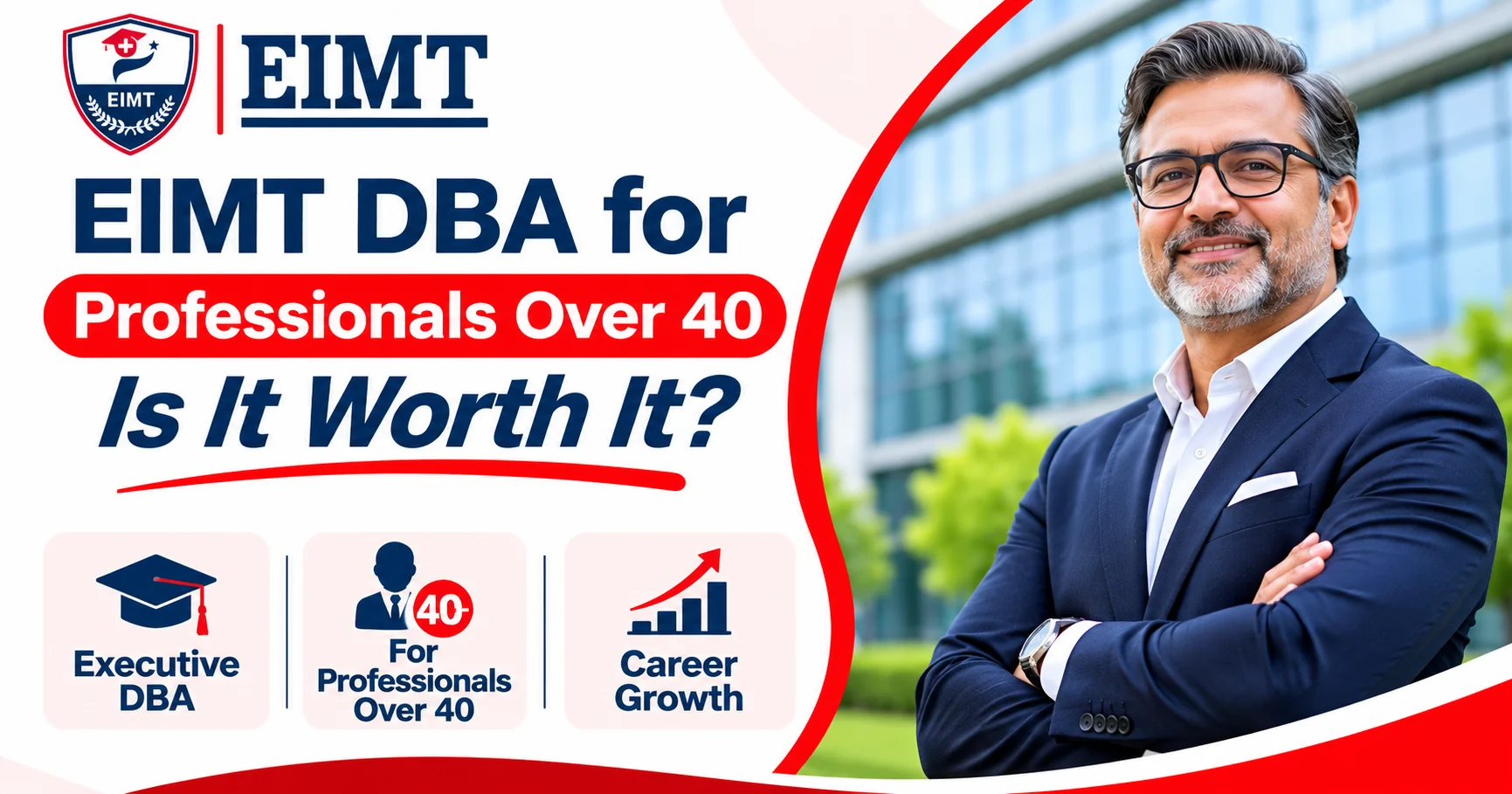
Is EIMT DBA Worth It for Professionals Over 40?
Yes, the EIMT DBA can be worth considering for professionals over 40, particularly those who want to advance into senior leadership positions, strengthen their consulting profiles or develop expertise through applied business research.
At this career stage, professionals usually have something valuable that younger students may still be developing: years of practical experience. They have encountered business challenges, made important decisions and learned how organisations operate.
A DBA allows them to examine these experiences through structured academic research.
Rather than focusing only on theoretical management concepts, the programme emphasises applying business knowledge to real organisational problems. Candidates can work on research connected to their professional interests and industry experience.
For someone who has spent 15–20 years in management, entrepreneurship or corporate leadership, this approach can make doctoral education more relevant and meaningful.
Why Should Professionals Over 40 Consider a DBA?
Choosing to pursue a doctorate after 40 is not about starting a career again. It is about developing existing professional strengths and creating new opportunities.
Here are some important reasons why experienced professionals may consider the EIMT DBA.
1. Strengthen Senior Leadership Opportunities
Professionals over 40 often have considerable management experience, but moving into higher executive positions can require additional strategic knowledge and credibility.
A DBA develops advanced capabilities in organisational management, research, strategic planning and decision-making.
These skills can be valuable for professionals targeting positions such as:
- Chief Executive Officer
- Chief Operating Officer
- Chief Strategy Officer
- Business Director
- Senior Management Consultant
- Head of Business Development
- Corporate Strategy Advisor
A DBA does not guarantee promotion or a particular designation. However, it can strengthen a professional’s academic and research profile alongside their existing experience.
2. Turn Professional Experience into Academic Knowledge
One of the biggest advantages of pursuing a DBA after 40 is the opportunity to use real professional experiences as the foundation for research.
For example, an experienced HR professional may investigate employee retention strategies, while a finance manager may research financial decision-making in large organisations.
Similarly, an entrepreneur could examine business expansion strategies, organisational innovation or leadership challenges.
This practical connection makes doctoral research more meaningful because candidates can explore problems they already understand.
3. Develop an Independent Consulting Career
Many experienced professionals eventually consider moving away from traditional employment.
Some want to establish independent consulting businesses, while others prefer working as strategic advisors, management experts or business coaches.
A DBA can help strengthen their professional positioning by developing research skills, analytical thinking and advanced management knowledge.
It may also help consultants demonstrate subject expertise when approaching organisations for advisory projects.
However, practical achievements, industry reputation and networking remain important factors in building a successful consulting career.
4. Explore Academic and Research Opportunities
Professionals over 40 who enjoy teaching, mentoring and knowledge sharing may also consider doctoral education as part of their academic development.
A DBA introduces candidates to research methodologies, academic writing and dissertation development.
After completing the programme, graduates may explore opportunities in:
- Business and management education
- Corporate training
- Executive development programmes
- Industry research
- Academic writing and publishing
- Management workshops
Academic employment requirements vary between institutions and countries. A DBA alone does not automatically guarantee eligibility for every university teaching position.
EIMT DBA Programme Overview
Before deciding whether the programme is suitable, professionals should understand its basic structure.
| Particulars | Details |
|---|---|
| Institution | European Institute of Management and Technology |
| Programme | Doctorate in Business Administration |
| Degree Award | Doctor of Business Administration |
| Duration | Approximately 36 months |
| Learning Mode | Online |
| Study Focus | Business Management and Applied Research |
| Eligibility | Recognised Master’s Degree or equivalent |
| Entrance Exam | No GMAT/GRE required |
| Research Component | Practitioner-based Dissertation |
| Study Format | Designed for Working Professionals |
The programme is structured to combine advanced management subjects with research and dissertation work. Its online delivery provides flexibility for professionals managing employment and personal responsibilities.
EIMT DBA Eligibility Criteria for Professionals Over 40
One common concern among experienced applicants is whether universities have an upper age limit for doctoral admissions.
The EIMT DBA admission information focuses on academic qualifications, English proficiency and digital competencies rather than specifying an upper age restriction.
The general admission requirements include:
1. Educational Qualification
Applicants should hold a recognised Master’s degree or an equivalent EQF Level 7 qualification.
The published admission criteria specify a minimum overall score of 55% or an equivalent GPA of 2.0 on a 4.0-point scale.
2. English Language Proficiency
Since the programme is delivered in English, candidates must demonstrate sufficient English communication skills.
IELTS, TOEFL or equivalent evidence may be required depending on the applicant’s educational and professional background. Certain applicants may qualify for an English proficiency waiver.
3. Digital Skills
Applicants should have basic digital knowledge, including familiarity with computers, internet-based learning platforms and common software applications.
4. Professional Experience
The programme is designed for experienced professionals who want to strengthen their management and research capabilities.
For applicants over 40, their professional background can provide valuable context for selecting a suitable research topic.
Importantly, meeting the eligibility requirements does not automatically guarantee admission. The institution reviews applications before making an admission decision.
What Makes the EIMT DBA Suitable for Working Professionals?
Returning to education after spending two decades in the professional world can be challenging. Professionals may have full-time employment, family responsibilities and business commitments.
The EIMT DBA offers several features that may help manage these responsibilities.
Fully Online Learning
The online learning format allows candidates to pursue doctoral education without relocating or regularly attending a physical campus.
This can be particularly useful for professionals who travel for work or manage organisations across different locations.
No GMAT or GRE Requirement
The programme does not require standard GMAT or GRE scores for regular admission.
This can make the application process more convenient for experienced professionals who have been away from formal examinations for many years.
One-to-One Research Mentorship
Research mentorship is an important part of doctoral education.
EIMT highlights individual supervision and academic guidance to support candidates throughout their research journey.
This can help professionals develop their research questions, understand methodologies and work towards completing their dissertations.
Practical Research Approach
The programme focuses on practitioner-based research and organisational projects.
Candidates can explore business challenges connected to their professional interests rather than treating research as an entirely separate academic activity.
What Can Professionals Over 40 Research in the EIMT DBA?
Choosing the right research area is one of the most important decisions when pursuing a DBA.
Professionals should ideally select a subject connected to their existing expertise, industry exposure or future career goals.
Some potential research areas include:
| Professional Background | Possible DBA Research Topic |
|---|---|
| HR Managers | Employee Retention and Organisational Performance |
| Finance Professionals | Strategic Financial Decision-Making |
| Marketing Managers | Digital Marketing and Consumer Behaviour |
| Entrepreneurs | Business Growth and Innovation Strategies |
| Operations Managers | Supply Chain Efficiency and Management |
| IT Professionals | Technology Management and Digital Transformation |
| Senior Executives | Leadership and Organisational Change |
| Healthcare Managers | Healthcare Administration and Service Quality |
These research areas allow experienced professionals to connect their industry knowledge with structured academic investigation.
EIMT DBA vs Continuing with an MBA After 40
Professionals sometimes wonder whether they should pursue another MBA or move directly towards a DBA.
Both qualifications serve different purposes.
| Comparison | MBA | DBA |
|---|---|---|
| Academic Level | Postgraduate | Doctoral |
| Main Focus | Business and Management Education | Advanced Business Research |
| Learning Approach | Case Studies and Management Concepts | Applied Research and Dissertation |
| Suitable For | Managers and Aspiring Leaders | Experienced Professionals and Executives |
| Career Objective | Develop Management Skills | Strengthen Research and Strategic Expertise |
| Research Component | Usually Limited | Significant |
| Professional Application | General Business Management | Research-Based Business Solutions |
If your objective is to build foundational management knowledge or transition into management, an MBA may be more appropriate.
However, if you already have substantial management experience and want to explore advanced research, consulting or academic opportunities, a DBA may be a better fit.
Career Opportunities After Completing the EIMT DBA
A DBA can support different professional directions, especially when combined with years of industry experience.
Senior Corporate Leadership
Experienced professionals may use their doctoral education to strengthen their profiles for senior management and executive opportunities.
Their existing leadership experience, combined with research-based decision-making skills, can be valuable in complex organisational environments.
Management Consulting
Professionals interested in consulting can use their research knowledge to evaluate organisational challenges, develop strategic recommendations and support business transformation.
Entrepreneurship
Business owners can explore research related to innovation, market expansion, organisational performance and long-term business sustainability.
Corporate Training and Mentoring
Experienced professionals may also consider corporate training, executive mentoring and management development opportunities.
Their professional experience and doctoral-level research knowledge can help them contribute to leadership development programmes.
Academic and Research Development
Graduates interested in academic careers can explore further research, academic publications and relevant teaching qualifications.
Candidates should check the academic employment and recognition requirements of their target country and institution before assuming that a DBA provides automatic teaching eligibility.
Challenges of Pursuing a DBA After 40
Although a DBA offers several potential benefits, professionals should also understand the challenges before enrolling.
Managing Time: Balancing doctoral studies with a demanding professional schedule requires discipline. Research, reading, assignments and dissertation development need consistent attention.
Academic Writing: Professionals with years of practical experience may initially find academic writing and research methodology challenging.
Research Commitment: A doctoral programme requires more than attending online classes. Candidates must develop research questions, evaluate existing studies, collect information and present meaningful findings.
Career Expectations: A DBA should not be viewed as an automatic route to a higher salary or executive designation. Career outcomes depend on experience, industry demand, individual performance and networking.
Understanding these challenges can help applicants make a more informed decision.
Is EIMT DBA a Good Investment for Professionals Over 40?
The value of a DBA depends on what you expect to achieve after completing it.
For someone interested only in receiving another academic qualification, the programme may not provide sufficient professional value.
However, for professionals who want to develop advanced research capabilities, strengthen their consulting profile or explore new leadership and academic opportunities, doctoral education can be a meaningful long-term investment.
Before enrolling, applicants should carefully evaluate the programme’s accreditation, awarding institution, qualification recognition in their intended country of use, academic support, dissertation requirements and overall learning commitment.
For Indian professionals, it is particularly important to understand that foreign accreditation does not automatically establish equivalence or recognition for every Indian employment, academic or regulatory purpose.
Final Verdict: Should You Pursue the EIMT DBA After 40?
Age should not be the only factor when deciding whether to pursue doctoral education.
Professionals over 40 often have extensive industry experience, leadership knowledge and practical understanding of business challenges. These strengths can provide a valuable foundation for applied doctoral research.
The EIMT DBA may be worth considering if you want to combine your professional experience with advanced management research, develop your strategic capabilities or explore consulting and academic opportunities.
Its online learning structure and research-oriented approach can make it an interesting option for experienced working professionals.
Ultimately, the right decision depends on your career objectives, academic background, available study time and the recognition requirements relevant to your future plans.
A doctorate after 40 is not about beginning again. It is about using what you have already learned to reach a new level of professional and academic development.
Frequently Asked Questions
1. Is EIMT DBA worth it for professionals over 40?
Yes, it can be worth considering for experienced professionals interested in senior leadership, business consulting, applied research and academic development. Its value depends on individual career objectives and qualification recognition requirements.
2. Is there an age limit for the EIMT DBA programme?
The published admission requirements do not specify an upper age limit. Applicants are evaluated based on academic qualifications and other admission requirements.
3. Can I pursue the EIMT DBA while working full-time?
Yes. The programme is delivered online and is designed to accommodate working professionals. However, candidates must dedicate sufficient time to coursework and dissertation research.
4. Do I need an MBA to apply for the EIMT DBA?
An MBA is not specifically mandatory. Applicants generally need a recognised Master’s degree or equivalent qualification that meets the programme’s admission criteria.
5. How long does the EIMT DBA take to complete?
The programme is designed to be completed in approximately 36 months.
6. Does EIMT require GMAT or GRE for DBA admission?
No. The published programme information indicates that GMAT and GRE scores are not required for standard DBA admission.
7. Can I become a business consultant after completing an EIMT DBA?
A DBA can strengthen your research, strategic thinking and business problem-solving capabilities. You can use these skills to explore consulting opportunities, although professional experience and industry credibility remain important.
8. Is the EIMT DBA suitable for entrepreneurs over 40?
Yes. Entrepreneurs can explore business growth, innovation, leadership, organisational development and other research areas connected to their businesses.
9. Can I pursue academic opportunities after completing the EIMT DBA?
Yes, graduates can explore research, academic publishing and relevant teaching opportunities. However, university appointment requirements vary, and additional academic qualifications may be necessary.
10. Is the EIMT DBA recognised in India?
Recognition depends on the awarding institution, accreditation status, qualification equivalence and the purpose for which the degree is being used. Indian applicants should independently verify the applicable recognition requirements before admission.